- The Longevity Code
- Posts
- Your inflammation might be a system error
Your inflammation might be a system error
How aging cells lose accuracy with inflammatory decision-making
THIS WEEK’S CODE:
💡 The focus → Aging cells overreact to signals that were once harmless.
⚠️ The impact → Chronic inflammasome activity drives many age-related diseases.
✅ The fix → Controlled stressors like heat recalibrate inflammatory signaling.
Read time: 4 minutes
IN PARTNERSHIP WITH…

The beginning of the year usually puts health back on the radar. After the holidays, we all start paying a little more attention to how we feel and what actually helps recover.
Heat may not be the first thought but a few sauna sessions a week has been linked to better recovery, lower inflammation, and improved sleep. It’s straightforward, doesn’t require much effort, and fits into a routine without changing everything else.
That’s why we like what Heavenly Heat is doing. Their infrared and red light saunas make starting a new health routine this year very simple, using heat and light in a way the body already knows how to respond to.
Not to mention we believe they are currently the healthiest sauna on the market using no toxic substances for assembly. But before you consider one, check out their mini sauna quiz if you're thinking of adding sauna to your wellness routine.
Anything that stays activated long enough eventually feels normal - for better or for worse.
Systems in our body tend to adapt to whatever signal repeats often enough, and over time “on” may stop feeling urgent, and much more expected.
This same pattern shows up at the cellular level.
Cells rely on structures called inflammasomes to detect danger and trigger short bursts of inflammation when it’s needed.
They’re designed to activate quickly, resolve the threat, and then stand down.
With age, that reset function becomes less reliable.
The outcome is ongoing inflammation that the body mistakenly treats as normal.

The cellular alarm system
At the center of this process is the NLRP3 inflammasome, a protein complex that acts like a cellular fire alarm.
When you’re younger, it activates briefly when genuine danger is detected, then powers down.
With age, NLRP3 becomes hypersensitive, firing in response to normal signals like oxidative stress, excess glucose, or damaged mitochondria.
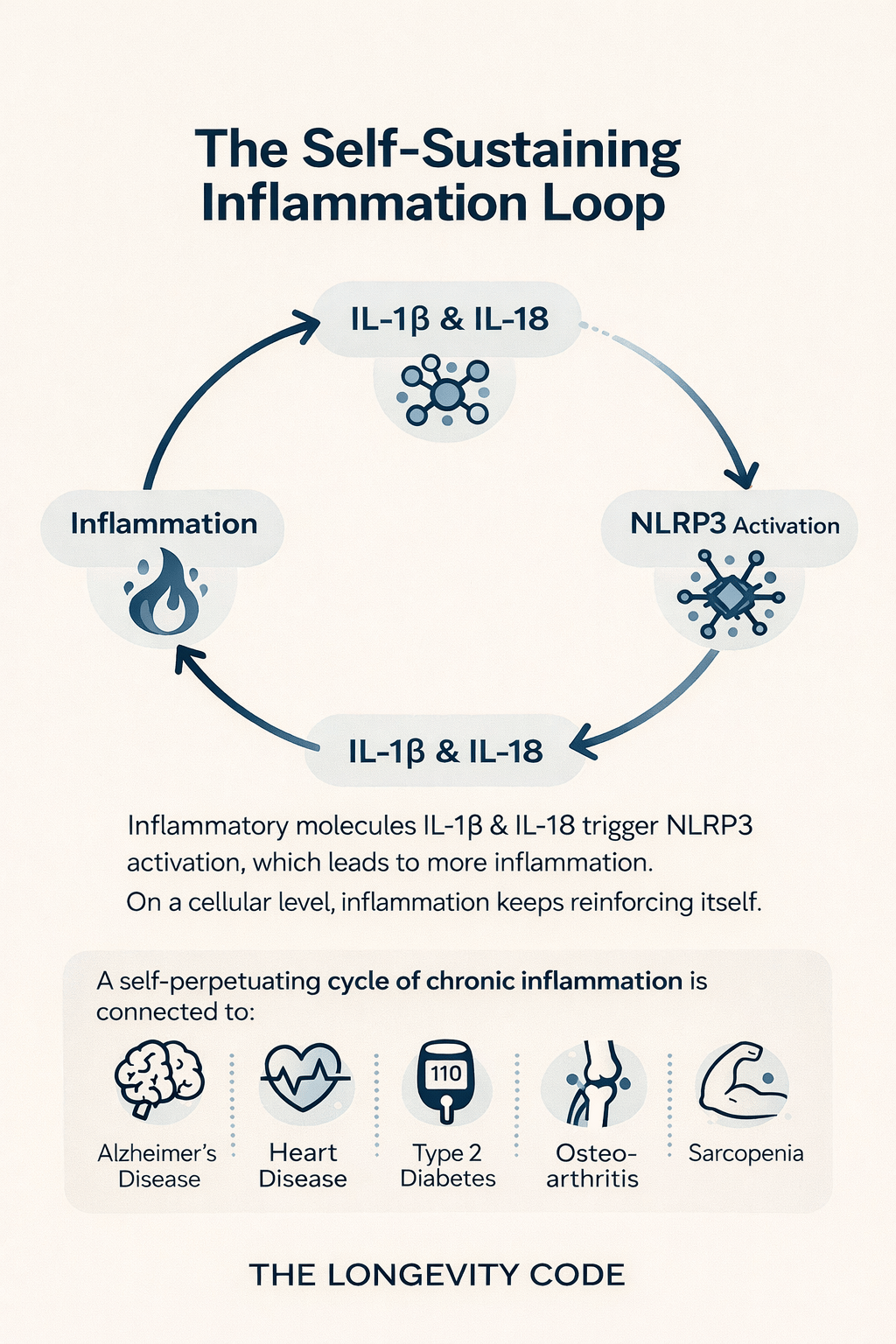
Once activated, it releases inflammatory cytokines including IL-1β and IL-18, which end up amplifying the problem.
An unwanted loop forms
There’s a loop that forms where IL-1β and IL-18 don’t just cause inflammation, they increase the likelihood that NLRP3 will activate again.
Essentially inflammation ends up creating conditions that trigger more inflammation, independent of new threats.
This self-reinforcing cycle is now linked to Alzheimer’s disease, atherosclerosis, type 2 diabetes, osteoarthritis, and even sarcopenia.
It’s less about acute damage and more about a background inflammatory signal that never fully quiets.
Stepping back to recalibrate
The goal isn’t to eliminate inflammation, which would be dangerous.
The goal is restoring proper thresholds, so cells stop overreacting to routine stress.
One of the most consistent non-pharmaceutical tools here is heat exposure.
Regular sauna use increases heat shock proteins, which help stabilize proteins, protect mitochondria, and directly inhibit NLRP3 activation.

Beyond heat
Stabilize energy signals
NLRP3 is highly reactive to mitochondrial stress and glucose volatility.
Regular low-intensity aerobic movement and fewer sharp blood sugar swings reduce the false danger signals that keep inflammasomes active.
Protect the sleep reset
Deep, regular sleep is one of the few times inflammatory signalling is actively down-regulated.
Consistent sleep timing matters more than duration when it comes to restoring proper immune thresholds.
Support inflammatory resolution
Inflammation is supposed to end, not linger.
Omega-3s help the body calm inflammatory signals instead of suppressing immunity - a lot of which can be easily obtained through supplementation or through natural sources like fish, seeds, and nuts.
Aging as a signal error
One of the subtle shifts that comes with age is where the immune system starts placing its attention.
Instead of responding to clear external threats, it increasingly turns inward, reacting to routine cellular debris and metabolic byproducts as if they matter more than they do.
This helps explain why so many age-related diseases look unrelated on the surface, yet share the same inflammatory signature underneath.
They aren’t driven by a single failure, but by a gradual misallocation of immune resources over time.
From a longevity perspective, the goal isn’t necessarily to eliminate inflammation altogether but rather reduce how often the body wastes responding to noise that may look and feel like inflammation.
Healthspan improves not only when defenses are stronger, but when they’re more selective as well.
TLDR TRIO
📈 Lower baseline inflammation without suppressing immune function
✅ Reduced risk signalling tied to metabolic and neurodegenerative disease
⌛ 3–4 sauna sessions per week, benefits accumulate over months