- The Longevity Code
- Posts
- Younger arteries, longer life
Younger arteries, longer life
Your vascular age gives hints to how old you really are
THIS WEEK’S CODE:
💡 The focus → How old your blood vessels really are
⚠️ The impact → The condition of your arteries can predict how long you live
✅ The fix → Boost nitric oxide and vessel flexibility to age slower
Read time: 4.5 minutes
IN PARTNERSHIP WITH…

It’s fitting this week’s newsletter is on vascular health given how good sauna can be for your cardiovascular system. Studies have shown sauna usage contributed to 50% decrease in cardiovascular disease and 63% decrease in sudden cardiac death.
Beyond the sweat, sauna is great for building resilience with your heart, vessels, and nervous system by teaching them how to handle stress more efficiently.
See for yourself and try the free sauna quiz in under a minute to find out which sauna may be right for you.
And be sure to explore Heavenly Heat’s Black Friday Sale, which includes up to $2600 off, free shipping ($900 value), and 50% off installation if needed.
You can train hard, eat well, and still feel older than your age.
The reason often hides in your arteries.
Vascular age shows how flexible and healthy your blood vessels are. As they stiffen, the heart has to push harder, oxygen delivery drops, and energy fades.
Workouts can start to feel heavier, recovery can take longer, and it can become harder to focus. These are quiet signs of aging from the inside out.
Most people carry arteries that are five to fifteen years older than their actual age. The cause is almost always the same: daily stress, lack of sleep, and long-term inflammation.

Why arteries get stiff in the first place
Doctors track a measure called pulse wave velocity, the speed of blood moving through your arteries. The faster that wave travels, the stiffer the arteries are. It’s one of the most reliable signs of future heart problems and even overall lifespan.
At the center of it all is a thin lining inside your vessels called the endothelium. It releases nitric oxide, a compound that helps blood vessels relax and stay smooth.
When the endothelium is damaged by stress, poor diet, or toxins, nitric oxide production falls, and vessels lose their natural flexibility. Over time, that stiffness builds into a lasting pattern of cardiovascular aging.
Determining vascular age
Most people have no idea how old their arteries really are but you can find out.
The gold standard for measuring it is carotid-femoral pulse wave velocity (cfPWV), essentially how fast blood moves through your arteries.
When arteries are stiff, blood travels faster. Studies show cfPWV predicts heart disease and all-cause mortality better than cholesterol, blood pressure, or BMI.
You can get a clinical PWV test at some cardiology or longevity clinics, or use smart blood pressure monitors that estimate it at home.
A few simpler signs can hint at your vascular age, too:
Resting heart rate: under 60 beats per minute usually means better arterial flexibility.
Blood pressure: consistent readings under 120/80 are linked with younger vascular profiles.
Cold hands and feet: often a subtle sign of reduced vessel function.
Recovery rate: the faster your heart rate returns to normal after exercise, the younger your vessels tend to be.

Your vascular age matters
Vascular age is one of the few indicators that shows how fast your body is aging beneath the surface.
Blood pressure, cholesterol, and weight change slowly, but vascular age responds within weeks, which makes it one of the most useful feedback loops you can track.
It influences almost every major system in your body:
How well your brain gets oxygen, affecting memory, focus, and mental sharpness.
How efficiently your muscles recover, affecting strength, stamina, and recovery.
How easily your heart pumps blood, affecting overall energy and longevity.
When your vascular age is lower than your actual age, it means your circulation, metabolism, and cellular health are running extremely efficiently, oftentimes a reflection of how healthy your lifestyle is.
The good news: It can be reversed
Arterial stiffness isn’t permanent. Your blood vessels are living tissue that adapt fast.
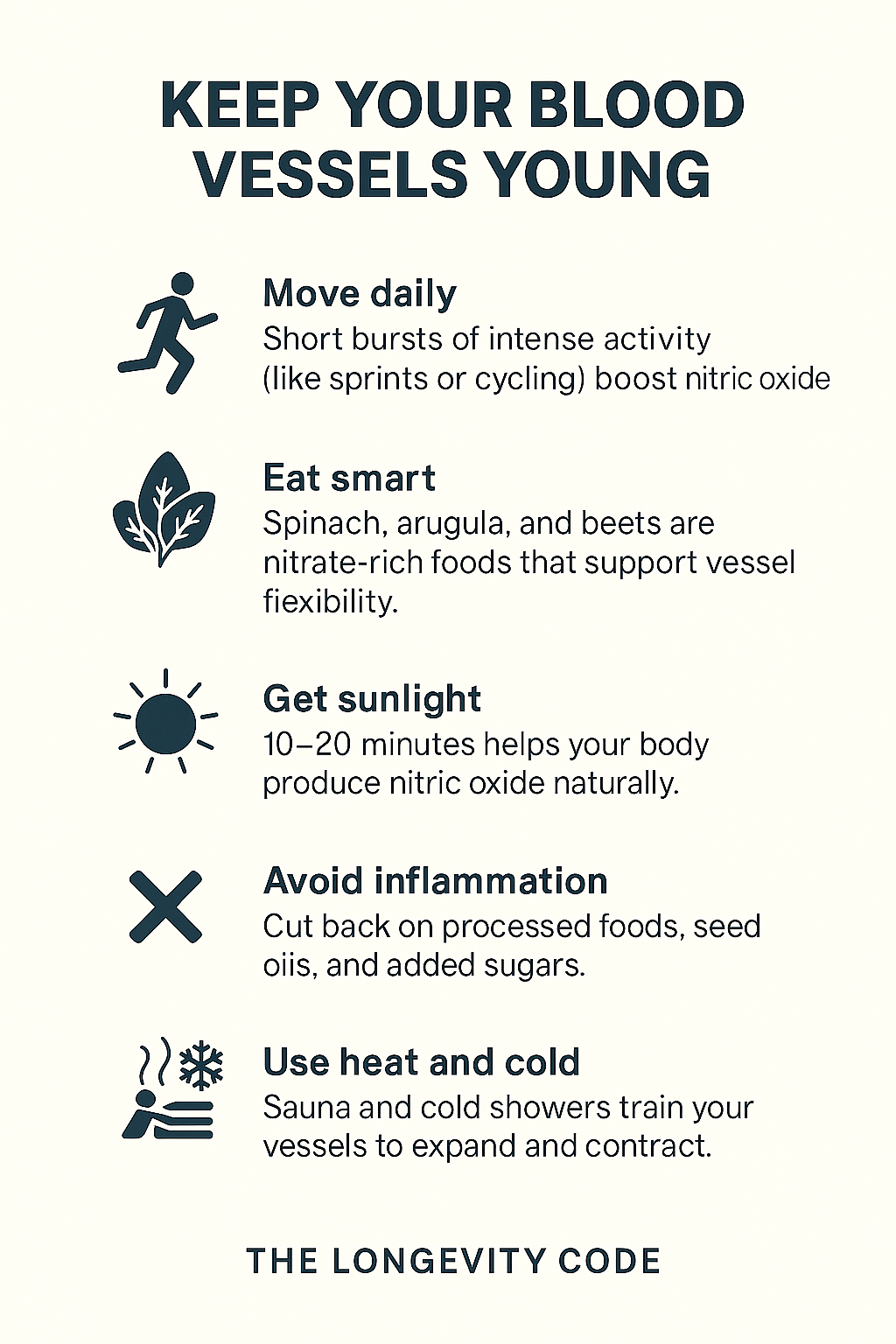
When you move, eat well, and lower inflammation, your body starts producing nitric oxide again. Within weeks, arteries can become more flexible, blood pressure can drop, and your vascular age can rewind by years.
This is one of the few aging markers you can actually change, if you know what to target.
Your real age isn’t on paper
The health of your vessels is one of the truest reflections of how young, or how old, you really are.
But here’s something most people miss: your arteries don’t just feed your heart, they also feed your brain.
When vessels stiffen, the brain’s delicate network of capillaries struggles to deliver oxygen. That’s one reason vascular aging is linked to cognitive decline, brain fog, and even dementia. The same habits that keep your heart young literally keep your brain sharp.
So while movement, eating well, and practicing protocols like sauna work well for your heart, there’s just as important of a byproduct with protecting your memory, your focus, and your ability to stay you.
TLDR TRIO
📈 Younger arteries = longer, sharper life.
✅ Better circulation, lower blood pressure, stronger heart and brain.
⌛ You can improve vascular age in as little as 4-8 weeks with daily movement and nitrate-rich foods.