- The Longevity Code
- Posts
- We don't notice this until years later
We don't notice this until years later
This part of the body that starts slipping long before you know it
THIS WEEK’S CODE:
💡 The focus → Muscle loss quietly begins in your 30s without resistance training.
⚠️ The impact → Less muscle weakens metabolism, strength, and brain health.
✅ The fix → Two weekly strength sessions help slow early muscle decline.
Read time: 5 minutes
IN PARTNERSHIP WITH…

We all need some form of winding down after a long day. Whether it’s controlled exposure to warm or cold temperatures, thermotherapy can do wonders for reducing stress and improving overall recovery once you’ve shut down for the day.
Including a sauna protocol, for instance, as part of your daily wind down routine has shown to have great benefit towards reducing stress and inflammation, amongst other benefits across the heart, brain, and joint health.
When you’re looking to health solutions that compliment everyday life, look to a company like Heavenly Heat Saunas.
The team there continues to help people figure out how to include things like sauna in their daily routines, no matter how busy life may get.
Take their free sauna quiz in under a minute to find out which Heavenly Heat offering might be right for you and your daily wind down routine.
Losing muscle? The gut reaction tends to be because of old age.
The reality is muscle loss begins many decades earlier - it just may not be noticed until your 50’s and 60’s.
For many adults, measurable decline starts sometime in their thirties when muscles are no longer regularly challenged.
The change is gradual enough that it rarely feels like it’s happening at all. Strength during everyday activities remains stable, and the scale may not move at all.
Muscle can slowly decrease while fat or water balance replaces it, making the shift difficult to notice.
Subtle signs often appear before people realize what is happening. Stairs may feel slightly more tiring than they once did, or a general sense of fatigue appears earlier in the day. These signals often reflect early muscle decline rather than a lack of sleep or motivation.

A natural sponge & brain fertilizer
Muscle tissue does far more than produce strength - it’s one of the body’s largest metabolic regulators and the primary place where glucose is cleared from the bloodstream after meals.
Because of this role, researchers often describe muscle as a “glucose sponge.”
When muscle mass declines, that sponge becomes smaller. Blood sugar stays elevated longer, forcing the pancreas to release more insulin to maintain balance. This increased workload raises the risk of insulin resistance and fatty liver even when overall body weight stays stable.
Muscle also communicates directly with the brain.
Contracting muscle releases signaling molecules known as myokines, which travel through the bloodstream and stimulate the production of brain-derived neurotrophic factor (BDNF). BDNF acts like a brain fertilizer, supporting neuron growth and helping to maintain cognitive function over time.
These biological signals help explain a pattern researchers consistently observe. Lower muscle strength, often measured through handgrip, has been associated with faster cognitive decline and a higher risk of dementia later in life.
Size doesn’t always matter
Many people worry about losing muscle size, but the body often loses strength faster than muscle mass itself. This process is known as dynapenia.
The reason is neurological. Strength depends on motor neurons that signal muscle fibers to contract.
With age, some of these neurons gradually disappear, reducing the nervous system’s ability to activate muscle effectively - resistance training helps preserve these pathways.
Regular strength work keeps motor neurons active and maintains the communication between the brain and the muscles they control. When that pathway fades, both the neural connection and the muscle fibers begin to weaken.
Focus on this kind of training
Cardio exercise supports heart health and endurance, but it does not provide the mechanical stimulus needed to preserve muscle. This is because aerobic activity primarily uses slow-twitch fibers, which are built for sustained effort rather than strength.
The muscle fibers most vulnerable to aging are fast-twitch fibers, responsible for power, balance, and rapid movement. These fibers are rarely recruited during steady-state cardio but are activated during resistance training.
Women face an additional variable. Muscle loss often accelerates during the late thirties as estrogen levels begin to decline. This hormonal shift increases the rate of muscle breakdown, meaning resistance training becomes increasingly important during this stage.
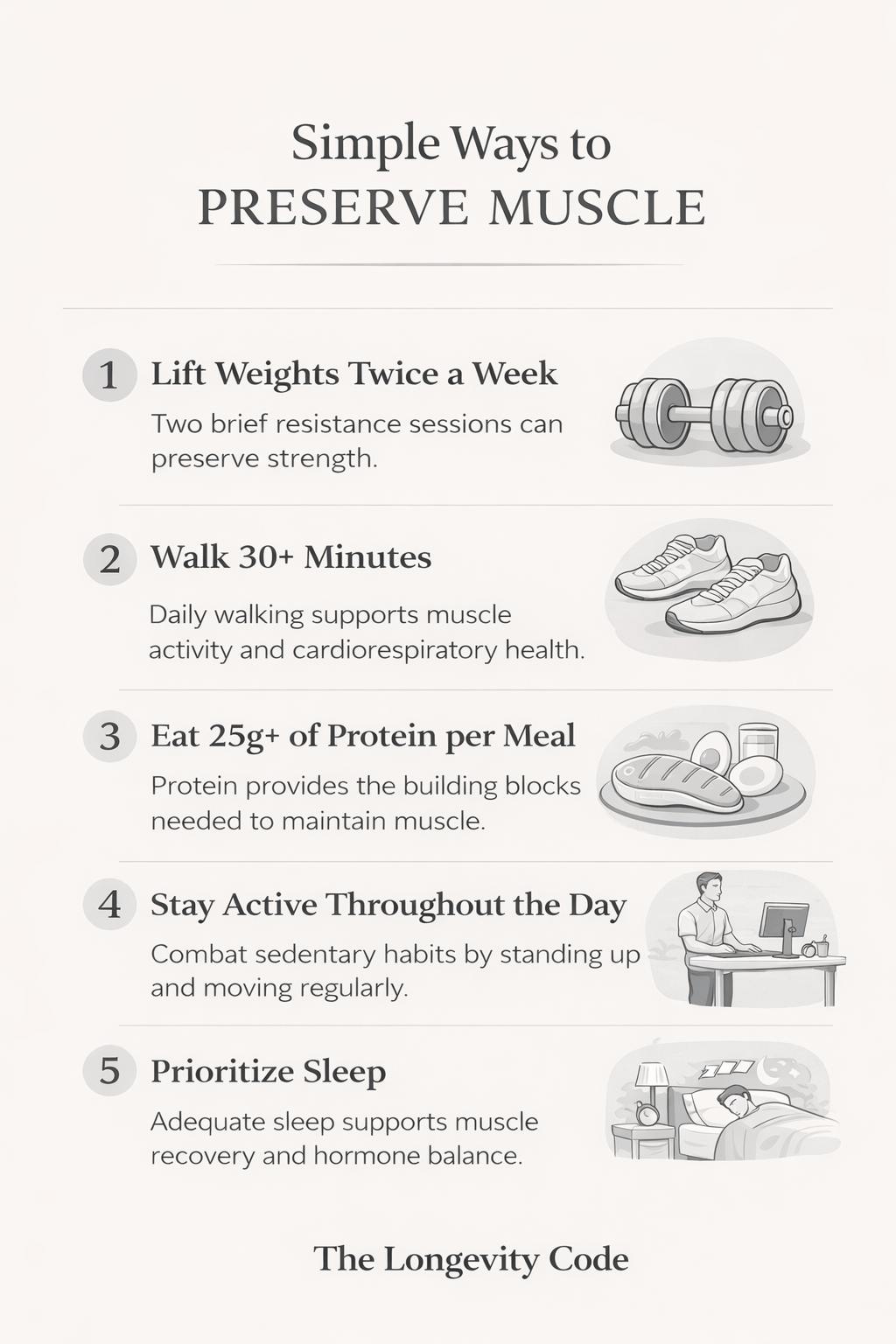
Fortunately, the body responds strongly to relatively small strength inputs. Research suggests that two full-body resistance sessions per week can be enough to maintain muscle and slow early decline.
Basic longevity predictor
Muscle is one of the strongest predictors of long-term survival.
Large population studies consistently show that people with greater muscle strength and higher lean mass have lower rates of cardiovascular disease, metabolic illness, and early mortality.
Part of this protection comes from muscle’s role in regulating blood sugar, inflammation, and energy metabolism across the entire body.
Strong muscle also preserves mobility and balance, which directly reduces fall risk and loss of independence as people age.
Researchers often refer to muscle as a “functional reserve” providing physical capacity that enables the body to tolerate illness, surgery, and periods of stress more effectively.
From a longevity perspective, strength training is not simply about fitness. It is one of the most reliable ways to preserve the biological systems that allow the body to remain capable, independent, and resilient over decades.

Muscle’s long term function
Muscle behaves differently from many other tissues in the body. It responds quickly to training when you’re young, but the capacity to rebuild lost muscle gradually declines with age.
The same stimulus that builds strength easily in your twenties often produces a smaller response decades later.
Researchers sometimes describe this as anabolic resistance. As people age, muscle becomes less sensitive to the signals that normally trigger repair and growth. Rebuilding lost muscle therefore requires more effort than maintaining it in the first place.
This is why early maintenance matters.
Strength habits established in midlife tend to preserve muscle more effectively than trying to rebuild it after decades of decline.
In practical terms, muscle behaves like a system that rewards consistency over time. The earlier it is maintained, the easier it is to preserve the strength and metabolic capacity that support long-term health.
TLDR TRIO
📈 Maintaining muscle supports metabolic health, brain function, and long-term resilience.
✅ Regular strength training helps preserve energy balance, stability, and physical capacity.
⌛ Two full-body strength sessions per week can help maintain muscle and slow early decline.